P.N.S. system
All Creatures Great and SmallThe P.N.S. system is Siegfried Farnon’s three-stage method for pursuing unpaid veterinary accounts: increasingly severe letters described as Polite, Nasty, and Solicitor’s. Its name promises a progression from courtesy to legal pressure, but the method exposes a weakness in the practice’s dealings with persistent debtors: the letters can be ignored when their recipients know that Siegfried is unlikely to carry the final threat through. The contrast between formal demands for payment and the meals, gifts, and kindnesses exchanged on farms makes the system part of a larger tension in rural veterinary work, where professional service and personal obligation continually meet.
Design and Limits
Siegfried has considerable faith in the graduated sequence, which lets him escalate a demand without beginning at its most confrontational level. Yet the letters seldom work against the hardest cases. Debtors accustomed to receiving threats in the morning post can yawn over the polite and nasty notices; the solicitor’s letter is no more persuasive if they have learned that Siegfried will shrink from taking matters to the limit of the law. The system therefore depends not only on the wording of each stage but on the credibility of the action implied by the last.
His feelings about clients who owe money are less consistent than the system itself. At times he flies into a fury at their names; at others he regards them with wry benevolence, joking that a cocktail party for the practice’s clients would have to invite the non-payers first because they are such charming fellows. That divided response matters: collecting fees is necessary, but Siegfried’s personal regard for some debtors makes enforcement difficult. The P.N.S. sequence supplies a formal structure for anger that he does not always sustain in practice.
Dennis Pratt and an Informal Alternative
Dennis Pratt demonstrates why the letters could fail against someone who was likable as well as indebted. About eighteen months before the proposed intervention, he had been subjected to the full P.N.S. system. It prompted him to pay five pounds on account, but no further money followed, leaving a substantial debt to the practice. Siegfried found it hard to get tough with a man he considered cheerful and hospitable.
Pratt’s warmth is rendered through practical, repeated gestures. When Siegfried and James Herriot arrived laughing at Pratt’s farm, Pratt joined in from across the yard, though he could not have heard what they had been discussing. After a job he invited them in for Mrs. Pratt’s baking; on cold days he kept hot coffee ready and poured rum freely into each cup. His conviviality makes the unpaid account harder to separate from the relationship formed through visits and treatment. The problem is not that he is described as openly hostile, but that friendliness has not produced regular payment.
Siegfried’s proposed remedy is social rather than legal. He reasons that payment may simply not occur to Pratt, and plans to place him in the practice on market day, seated where he can see other farmers paying their accounts. Siegfried intends to leave him there for about half an hour while he attends a dog in the operating room, hoping that the sight of cheque books, coins, and notes will prompt him to pay. Herriot remains dubious: he has seen Siegfried produce ideas both brilliant and barmy, and cannot tell which kind this is. Siegfried nevertheless insists that it is worth trying. The account records the plan and Herriot’s doubts, but does not establish its outcome; the episode shows an attempted alternative to the P.N.S. system, not proof that the alternative succeeded.
Horace Dumbleby and the Cost of Pressure
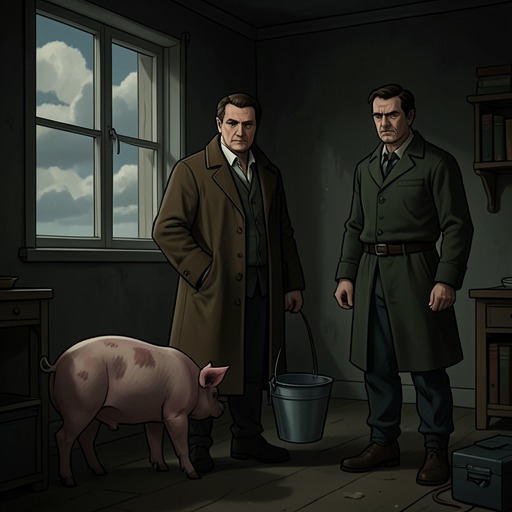
The case of Horace Dumbleby reveals a different consequence of applying the letters. Dumbleby was a small-scale farmer and butcher, with six milk cows, some bullocks and pigs, and a shop whose products included sausages, pies, roasting cuts, and chops. Though he seemed comfortably established and was said to own property in several places, Siegfried saw little of his money. Like other slow payers, Dumbleby expected immediate attendance when an animal was in trouble, a contrast that could make Siegfried’s patience snap.
After a Sunday-night call at ten o’clock, Siegfried became enraged and unleashed the full force of the P.N.S. system. It did not loosen Dumbleby’s purse strings; instead, it wounded his feelings. Dumbleby appeared to regard himself as the injured party, and thereafter turned to stare blankly at Herriot whenever their paths crossed in the country. Herriot began seeing him more often, and the silence of the look made the dispute feel increasingly oppressive. At the Aldgrove pub, Dumbleby’s fixed, disapproving gaze followed him even when Herriot and Tristan moved from the bar into the snug. The formal pursuit of a debt had thus produced no reported payment and left a personal grievance that reached beyond the practice’s accounts.
A later visit complicates that estrangement without resolving the account. After Herriot helped deliver Dumbleby’s living twin calves, he noted that they were valuable and that it was fortunate they had survived. Dumbleby did not answer, so Herriot could not tell whether the remark had affected him. As Herriot dressed and followed him through the butcher’s shop, past hanging beef, trays of offal, and freshly made sausages, Dumbleby stopped near the door and offered him some. Herriot accepted, astonished at the gesture. When Herriot then asked how much he owed, Dumbleby froze before managing to say that the price was two and sixpence. The exchange preserves the awkwardness of charging for something while also allowing a small act of generosity; it does not say that Dumbleby paid his veterinary debt.
Accounts, Hospitality, and Rural Practice
The P.N.S. system operates within a practice where money is only one part of the relationship between veterinarian and farmer. Farmers who were disappointed to see Herriot rather than Siegfried could still invite him into their homes for dinner; some put half a dozen eggs or a pound of butter into his car as he left. Such hospitality was traditional in the Dales, and Herriot understood that it was offered to visitors generally, yet it also revealed friendliness beneath an initially unsmiling manner. These gifts are not presented as payment of veterinary bills, but they show why professional dealings cannot be reduced to invoices alone.
The exchange runs in both directions through work and assistance. Ruth Bellerby asks Herriot to drive her family to Darrowby church for a performance of the Messiah because preparing their pony and trap would be difficult and slow; he agrees, and is going to hear the music himself. On another call, in a snowstorm, Horace Clayton greets the exhausted Herriot by saying that he has just finished dinner and needs only a moment to fetch his hat before taking him to the sick animal. Meals, lifts, gifts, and veterinary attendance belong to a world of reciprocal contact, while the P.N.S. letters assert the practice’s right to collect fees. The system’s recurring failure marks the friction between those forms of exchange: kindness may sustain working relationships, but it does not reliably settle accounts, and a demand for money may injure the very relationship on which continued cooperation depends.